
The digital marketing landscape has dramatically shifted. As we navigate through 2026, search engines are smarter, user behaviors have fundamentally changed, and generative AI search platforms are no longer a future prediction—they are the current standard. If you want your website to stay competitive, drive sustainable organic traffic, and secure top spots on Google’s search engine results pages (SERPs), traditional optimization methods alone won’t cut it.
While off-page signals like high-quality backlinks and brand authority remain crucial, your foundational success relies entirely on how well your content is structured, understood, and experienced by both humans and machine learning algorithms. This is where modern SEO optimization proves its worth. By ensuring your website answers queries perfectly, loads instantly, and offers an unmatched user experience, you create an authoritative presence that search engines cannot ignore.
Whether you are a seasoned marketer looking to refine your workflow, an ambitious business owner wanting to grow your online visibility, or a beginner stepping into digital marketing, this comprehensive On-Page SEO Checklist will give you a clear roadmap to optimize your content, improve your site architecture, and command higher Google rankings in 2026.
What is On-Page SEO?
On-page SEO refers to the practice of optimizing individual web pages to rank higher and earn more relevant organic traffic in search engines. Unlike off-page SEO, which focuses on external signals like backlinks and digital PR, or technical SEO, which deals with backend architecture and server configurations, on-page SEO is entirely under your direct control. It includes everything you publish on your site: the written words, the HTML source code, structural formatting, metadata, internal linking structures, and rich media elements.
In 2026, the definition of on-page SEO has expanded significantly. It is no longer just about placing a specific keyword phrase into a paragraph a set number of times or ensuring a meta tag fits an exact character length. Today, effective on-page SEO techniques balance high-quality human writing with technical clarity that allows AI-driven search models—such as Google’s advanced Search Generative Experience (SGE) and large language frameworks—to instantly extract, parse, and cite your content as the single best answer to a user’s question.
Why On-Page SEO Matters More Than Ever in 2026
Google’s search algorithm has evolved from matching simple keyword strings to deeply understanding topical authority, semantic context, and direct user satisfaction. Modern Google ranking factors prioritize content depth, expert credibility (E-E-A-T), and zero-friction user experiences. If your on-page optimization is weak, even the most expensive backlink campaign won’t save your rankings.
Here is why focusing on your on-page structure is crucial right now:
- AI and Search Generative AI Integration: Search engines use advanced AI models to synthesize data. If your page lacks structural headers, clear definitions, and logical hierarchies, AI algorithms cannot accurately summarize or feature your content in conversational search outputs.
- Direct Answer Dominance: With zero-click searches reaching all-time highs, your content must be structurally optimized to secure featured snippets, “People Also Ask” boxes, and direct answer blocks.
- User Experience as a Direct Signal: Search engines monitor real-time user behavior. Elements like dwell time, click-through rates (CTR), and interaction patterns directly influence your visibility. If a visitor lands on an unoptimized, hard-to-read page and bounces back immediately, your search positions will drop.
- Maximum Return on Efficiency: On-page optimization requires no outreach, no external dependencies, and no media buying budget. It relies entirely on your internal workflow, making it the most cost-effective way to scale your digital presence.
The Ultimate Step-by-Step On-Page SEO Checklist for 2026
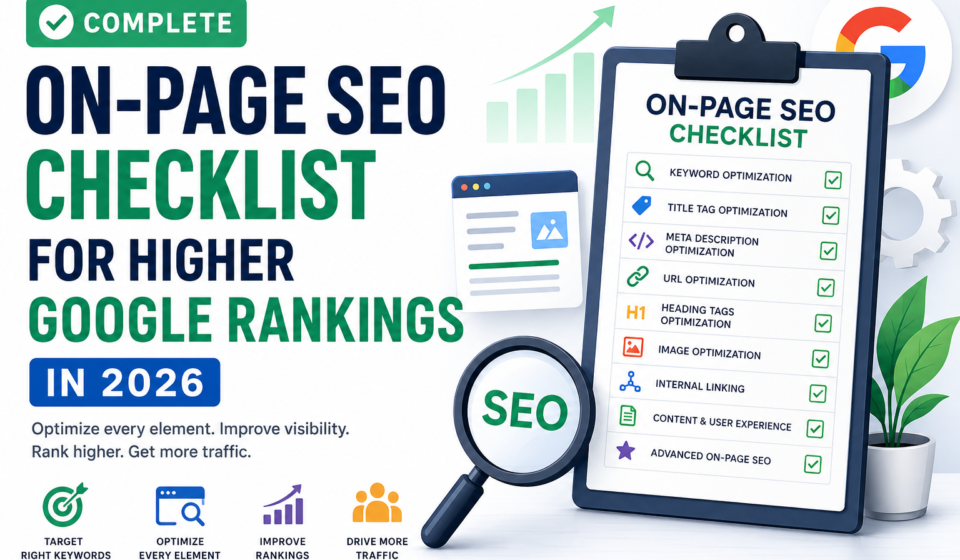
To ensure your web pages are fully optimized for maximum search visibility, execute this comprehensive checklist for every piece of content you publish. We have broken this process down into five core pillars: Core Metadata, Strategic Keyword Mapping, Structural & UX Optimization, Image & Media Enhancements, and Advanced Semantic Authority.
1. Core Metadata & Initial Setup
First impressions happen before a user ever visits your website. Your metadata serves as the digital storefront in search results, directly impacting your organic click-through rate.
- Craft a Catchy, Keyword-First Title Tag: Place your primary keyword near the beginning of your meta title. Keep the length between 50 to 60 characters to avoid truncation in SERPs. Make it highly compelling by addressing the user’s primary problem or indicating a definitive guide (e.g., “Complete On-Page SEO Checklist for 2026”).
- Write Action-Oriented Meta Descriptions: Keep descriptions under 155 characters. While meta descriptions are not a direct ranking factor, they act as ad copy for your organic listing. Include a clear call-to-action (CTA) and relevant secondary keywords to encourage clicks.
- Clean and Descriptive URL Structures: Build short, lowercase URLs that clearly state what the page is about. Use hyphens to separate words and strip out unnecessary parameters, numbers, or dates. For example, use
example.com/blog/on-page-seo-checklistinstead ofexample.com/p=48293?date=2026.
2. Strategic Keyword Mapping & Search Intent Alignment
Keyword stuffing is obsolete. In 2026, SEO best practices demand that keywords are used naturally to establish context, map directly to user intent, and provide clarity to search engine crawlers.
- Satisfy the True Search Intent: Before writing, search for your target term. Is the user looking to buy (transactional), learn (informational), find a specific site (navigational), or research options (commercial)? Align your content layout exactly with what Google is already ranking on page one. If page one contains actionable guides, do not publish a generic sales page.
- The First 100-Word Keyword Placement: Introduce your primary phrase organically within the opening paragraph. This quickly signals to readers and search engine crawlers that the page directly covers the promised topic.
- Integrate LSI and Semantic Phrases: Use natural variations, synonyms, and conceptually related terms throughout your content. If you are writing about SEO, naturally include terms like “search visibility,” “organic traffic,” “search algorithm,” and “indexing.” This establishes comprehensive topical depth.
- Maintain Natural, Balanced Keyword Density: Avoid forced repetition. Focus on writing comprehensive, clear sentences. A natural density often falls between 0.5% and 1.5%. If a sentence sounds awkward when read aloud, rewrite it.
3. Structural Content & UX Optimization
Once a user lands on your site, they need a clear, readable path. A well-structured page keeps users engaged longer, signaling high content quality to search engines.
- Enforce a Strict Heading Hierarchy (H1, H2, H3): Ensure each page features exactly one unique H1 header containing your primary topic. Use H2 headers for major sections and H3 headers for subsections. This structural breakdown helps search crawlers scan your document layout seamlessly.
- Design for Skimmability: Online audiences scan content rather than reading every word. Keep paragraphs limited to 2–3 sentences. Incorporate frequent bold accents, blockquotes, and clean bullet points to break up dense blocks of text.
- Optimize for Mobile-First Display: With mobile devices driving the vast majority of web traffic, ensure your typography, line heights, and element spacing adjust flawlessly to smaller screens. Test for overlapping text or clipped blocks.
- Implement Smart Internal Linking Architecture: Link out to 3–5 relevant internal pages using descriptive anchor text (avoid generic phrases like “click here”). Similarly, edit existing authority pages on your site to link back to your new post. This distributes page authority and encourages longer user journeys.
- Incorporate Trusted External Links: Link out to high-authority, non-competitive external sources, such as academic studies, official documentations, or industry reports. This validates your claims and shows search engines that you prioritize providing verified, accurate information.
4. Image, Media, & Visual Asset Optimization
Rich media makes articles engaging, but unoptimized files can severely slow down your site and damage your user experience metrics.
- Write Descriptive Alt Text for Every Image: Use clear, descriptive alt attributes for all images. Describe exactly what is shown in the visual asset, incorporating relevant keywords naturally where appropriate. This helps visually impaired users and allows search engines to accurately index your images in visual search results.
- Utilize Modern WebP or AVIF Image Formats: Avoid uploading heavy PNG or JPEG files. Convert all visual assets into highly compressed, modern web formats to minimize file sizes without losing visual quality.
- Strict Image Compression Workflows: Ensure no image uploaded exceeds 100–150KB. Run images through optimization pipelines to strip unnecessary metadata before publishing them to production.
- Explicitly Define Width and Height Dimensions: Always declare layout dimensions on your image HTML tags. This preserves layouts during loading, preventing unexpected shifts and protecting your Core Web Vitals scores.
5. Advanced Semantic Authority & Technical Harmony
To truly stand out in 2026, your on-page strategies must align seamlessly with technical enhancements that provide clear context to search engines.
- Deploy Relevant Schema Markup: Inject clean JSON-LD structured data into your page code. Whether utilizing Article, Product, FAQ, or HowTo schema, this explicit technical data helps search engines understand your content structure and awards your site rich snippet visual features in SERPs.
- Prioritize Core Web Vitals Metrics: Monitor and maximize your actual user performance scores. Focus on lowering your Largest Contentful Paint (LCP), eliminating Cumulative Layout Shift (CLS), and minimizing Interaction to Next Paint (INP). A fast, highly responsive page ranks better.
- Format and Optimize for Featured Snippets: Provide explicit, single-sentence answers to target questions directly beneath clear H2 or H3 headers. Use clean HTML tables or ordered lists to make it easy for search algorithms to pull your data into highlighted search answers.
Common On-Page SEO Mistakes to Avoid
Even experienced digital marketers fall into traps that can stall organic growth. To protect your search engine visibility, avoid these common on-page mistakes:
| Mistake | Why It Harms Your Rankings | How to Fix It |
| Keyword Stuffing | Makes content unreadable for users and alerts spam filters. | Write naturally. Use synonyms and let your keywords fit into context organically. |
| Ignoring Search Intent | Leads to high bounce rates when visitors don’t find what they expect. | Analyze page-one results before writing to align your layout with user expectations. |
| Broken Links | Frustrates users and cuts off the flow of crawl equity. | Audit your internal links quarterly and fix dead paths immediately. |
| Duplicate Titles & Content | Confuses search engines on which URL to rank, leading to self-cannibalization. | Ensure every page has unique written copy and distinct meta tags. |
| Neglecting Mobile UX | Causes mobile visitors to drop off instantly, dropping your ranks. | Use responsive layouts and test your design across multiple mobile devices. |
The Best Tools for On-Page SEO in 2026
You don’t have to handle optimization blindly. Leveraging specialized software helps automate data audits, content optimization, and performance tracking. Here are the top tools to add to your marketing workflow:
- Google Search Console (Free): The most critical platform for direct search insight. Use it to check indexation health, analyze actual search queries, identify impressions, and spot mobile accessibility bugs.
- Surfer SEO / Clearscope (Paid Optimization Suites): These platforms use real-time AI to analyze current top-ranking pages. They guide your writing workflow by recommending ideal word counts, heading structures, and semantic terms to include.
- Semrush / Ahrefs (All-in-One Platforms): Excellent for comprehensive keyword research and competitive content analysis. Their built-in on-page auditing tools quickly crawl your site to flag missing meta tags, broken internal links, and content cannibalization risks.
- Screaming Frog SEO Spider (Technical Auditing): A powerful desktop application that crawls your website to find duplicate pages, evaluate status codes, review header distributions, and identify metadata issues at scale.
- PageSpeed Insights (Free Core Metrics Tool): Google’s official engine for evaluating real-world user performance. It provides actionable recommendations to optimize code execution, compress media, and improve Core Web Vitals.
Conclusion
Success on Google in 2026 requires moving past outdated hacks and focusing on what matters most: delivering a high-quality user experience. On-page SEO is your foundational tool to bridge the gap between user intent and search engine comprehension. By systematically applying this On-Page SEO Checklist, you ensure your content is clear, readable, fast, and structured for success.
SEO is an ongoing process of testing, learning, and refining. Start by updating your most valuable pages today, optimize your technical assets, and build comprehensive topical authority. Consistent optimization will help you secure sustainable organic growth and higher search visibility.
Frequently Asked Questions (FAQs)
How long does it take for on-page SEO modifications to influence rankings?
On-page updates can influence search visibility within a few days to a few weeks. The timing depends heavily on how frequently search engine crawlers review your website. To speed up the process, submit your updated URL directly through Google Search Console to request prompt re-indexing.
Are meta keywords still relevant for search rankings?
No. Major search engines like Google abandoned meta keyword tags years ago because they were easily abused. Focus your efforts instead on creating a descriptive title tag, an engaging meta description, and optimized content structure.
What is the ideal word count for an SEO-focused blog post?
There is no single ideal length. Your content should be long enough to thoroughly answer the user’s question and cover the topic in-depth. Some informational topics require detailed guides of 2,000+ words, while specific answers might only need 500 words. Analyze what is currently ranking on page one to determine the best length for your topic.
Can an over-optimized page hurt my rankings?
Yes. Over-optimization occurs when content feels forced, such as stuffing keywords into every heading or creating unnatural sentences just to fit a phrase. This creates a poor user experience and can trigger quality algorithms that lower your site’s visibility.
How often should I review and update my existing content?
Review your high-traffic and core pages at least once a year. Update outdated facts, fix broken links, add new insights, and re-optimize elements based on shifting search trends to keep your content fresh and competitive.
Ready to Scale Your Organic Traffic & Dominate Google Search?
Keeping up with shifting search engine algorithms, technical updates, and content optimization workflows can feel overwhelming when running a business. Our dedicated team of SEO experts is here to help. We build custom, data-driven optimization strategies that improve your search rankings, increase conversions, and drive sustainable revenue growth.