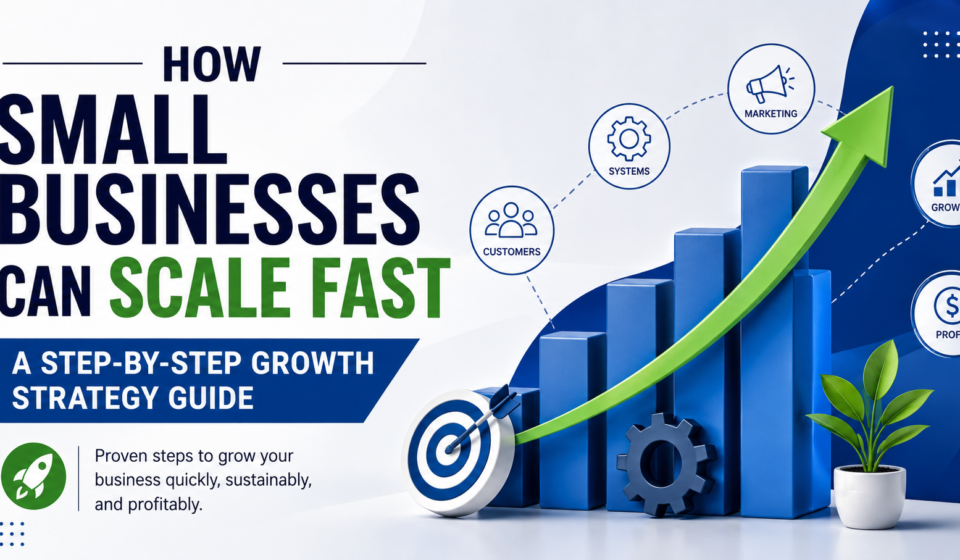
How Small Businesses Can Scale Fast: A Step-by-Step Growth Strategy Guide

Scaling a business is the ultimate dream for most entrepreneurs. It is the exciting transition from surviving to thriving, where your brand expands its footprint, increases its market share, and dramatically boosts its revenue.
However, there is a profound difference between growing a business and scaling a business.
Growing means you are adding resources at the same rate you are adding revenue. If you gain a new client but have to hire a new employee just to handle that single client, you are growing, but your profit margins stay flat. Scaling, on the other hand, means increasing your revenue exponentially while only increasing your operating costs incrementally. It is about building a business model that can handle a massive influx of work without breaking a sweat.
If you are ready to take your business to the next level, you need more than just luck; you need a repeatable blueprint. This step-by-step guide will show you how to scale fast, build a resilient team, and unlock sustainable revenue growth.
Step 1: Set Crystal-Clear, Scalable Goals
You cannot reach a destination if you don’t know where you are going. Scaling too quickly without a clear roadmap is one of the leading causes of small business failure. To scale fast, you must transition from vague aspirations to structured, data-driven objectives.
Look Beyond the Numbers
While hitting a revenue milestone is fantastic, scalable goals look at the infrastructure required to support that revenue. Instead of simply saying, “We want to make $1 million this year,” shift your focus to measurable capacity goals:
- Infrastructure Targets: “We will automate our onboarding process to handle 50 new clients per month without increasing manual admin hours.”
- Market Expansion: “We will launch our e-commerce storefront in two neighboring regions by Q3.”
- Operational Efficiency: “We will reduce product manufacturing turnaround times by 15% using new inventory software.”
The OKR Framework
Many of the world’s fastest-growing companies use the Objectives and Key Results (OKRs) framework.
- The Objective is your qualitative, motivational goal (e.g., “Become the highest-rated local eco-friendly cleaning service”).
- The Key Results are quantitative metrics that prove you achieved it (e.g., “Secure 150 5-star Google reviews” and “Maintain a 92% customer retention rate”).
Step 2: Build a Scalable Business Model and Refine Systems
Before you pour fuel on the fire by investing heavily in marketing or hiring, you must ensure your business foundations can support the weight of rapid growth. If your internal processes are disorganized, scaling will only magnify those inefficiencies.
Document and Delegate (SOPs)
If you, the founder, are the only person who knows how to run the day-to-day operations, your business cannot scale. You become the ultimate bottleneck. To scale fast, you must create Standard Operating Procedures (SOPs) for every repeatable task in your company.
Real-World Example: Consider a local boutique bakery looking to scale into a regional franchise. If the head baker keeps all the recipes and baking schedules in their head, opening a second location is impossible. By documenting exact ingredient weights, mixing times, oven temperatures, and supplier contact lists into a digital SOP dashboard, any trained baker can replicate the success of the original kitchen.
Automate and Outsource
In the digital age, human labor should be reserved for high-value tasks like strategy, creativity, and relationship building. Leverage technology to handle the rest:
- Use Customer Relationship Management (CRM) tools like HubSpot or Salesforce to track leads automatically.
- Implement email marketing platforms to send automated welcome sequences and abandoned cart reminders.
- Utilize project management tools like Asana, Trello, or Monday.com to keep your team aligned without needing constant status update meetings.
Step 3: Architect a High-Performance Team
You can only go so far on your own. True scaling requires shifting your role from an operator (someone who works in the business) to a leader (someone who works on the business). To make that leap, you need a team you can trust implicitly.
Hire for Cultural Fit and Train for Skill
When building a startup or small business team, a single toxic employee can derail your entire company culture. Look for individuals who share your core values, possess high emotional intelligence, and exhibit adaptability. In a fast-scaling environment, job roles will evolve quickly; you need people who view change as an exciting challenge rather than a burden.
The Art of Strategic Delegation
As a founder, it is incredibly difficult to let go of your “baby.” However, micromanagement is the absolute enemy of speed.
- Identify your unique strengths (your zone of genius) and spend 80% of your time there.
- Delegate tasks that fall outside your strengths to specialists. If you are a brilliant product designer but a terrible accountant, hire a part-time CFO or fractional accountant immediately.
- Empower your team to make decisions within their domains without needing your sign-off for minor tasks.
Step 4: Maximize Customer Retention (The Hidden Engine of Growth)
Most business owners assume that scaling is entirely about acquiring new customers. This is an expensive misconception. It costs anywhere from 5 to 25 times more to acquire a new customer than it does to retain an existing one.
If you are losing customers out of the back door as fast as you are bringing them in through the front door, you aren’t scaling—you are spinning your wheels.
[High Churn Rate] ➔ Constant Expensive Marketing ➔ Stagnant Growth
[Low Churn Rate]  ➔ Compounding Recurring Revenue ➔ Fast, Exponential Scaling
Cultivate Extreme Customer Loyalty
When customers stay with you long-term, your Customer Lifetime Value (CLV) skyrockets, giving you more capital to reinvest into your business.
- Over-Deliver on Customer Service: Resolve issues quickly, transparently, and with empathy. A customer who has a problem solved brilliantly often becomes a more loyal advocate than one who never experienced an issue at all.
- Build a Loyalty Program: Reward repeat purchases with exclusive discounts, early access to new products, or a point-based rewards system.
- Actively Seek Feedback: Don’t guess what your customers want. Use Net Promoter Score (NPS) surveys to regularly check the pulse of your audience and implement their feedback to continuously refine your offerings.
Step 5: Diversify and Supercharge Your Revenue Streams
To scale fast, you need predictable, compounding revenue. Relying on a single product or a one-time transaction model makes your business vulnerable to market fluctuations.
Create Recurring Revenue Models
Look for ways to convert one-off buyers into long-term subscribers.
- If you run a service-based agency, move away from hourly billing and transition into monthly retainer packages.
- If you sell physical products, introduce a “Subscribe and Save” model where customers receive automated monthly deliveries of your goods at a slight discount.
Cross-Selling and Upselling
It is significantly easier to sell more to an audience that already trusts you than it is to convert a complete stranger.
- Upselling: Encourage customers to purchase a premium, higher-end version of your product or service during checkout.
- Cross-Selling: Recommend complementary products that enhance their primary purchase (e.g., offering a specialized maintenance kit alongside a premium appliance purchase).
Step 6: Fuel Growth with Targeted Marketing
Once your systems are efficient, your team is aligned, and your customer retention is stable, it is time to pour fuel on the fire. Rapid scaling requires a multi-channel marketing approach that consistently generates high-quality leads.
Double Down on Content Marketing and SEO
Paid ads are highly effective, but they stop generating leads the second you stop paying for them. Search Engine Optimization (SEO) and high-value content marketing act as long-term business assets that attract organic traffic for years.
- Publish authoritative, deeply helpful blog posts that answer your audience’s most urgent questions.
- Optimize your local and national SEO so your website ranks at the absolute top of search engine results when buyers are ready to purchase.
Leverage High-ROI Paid Advertising
Use data-driven paid social media campaigns and search engine ads to rapidly scale your reach. Start with modest daily budgets, ruthlessly track your conversion rates, and heavily reinvest your capital into the specific ad creatives and audience segments that yield the lowest Customer Acquisition Cost (CAC).
Conclusion: Step Into Your Leadership Era
Scaling a small business fast isn’t about working 80-hour weeks or trying to do every task yourself. True scaling is an intentional, strategic exercise in building robust systems, empowering an exceptional team, protecting your customer base, and executing repeatable processes.
By taking a step back from the daily weeds of your business and focusing on these foundational steps, you will create a highly efficient revenue engine built to thrive under pressure. The path to exponential growth is right in front of you—take it one structured step at a time.
Accelerate Your Scaling Journey with GrowthPulseSol
Ready to build a business that scales seamlessly without burning you out? At GrowthPulseSol.com, we specialize in designing customized growth strategies, optimizing digital funnels, and building high-impact marketing systems for ambitious small businesses.