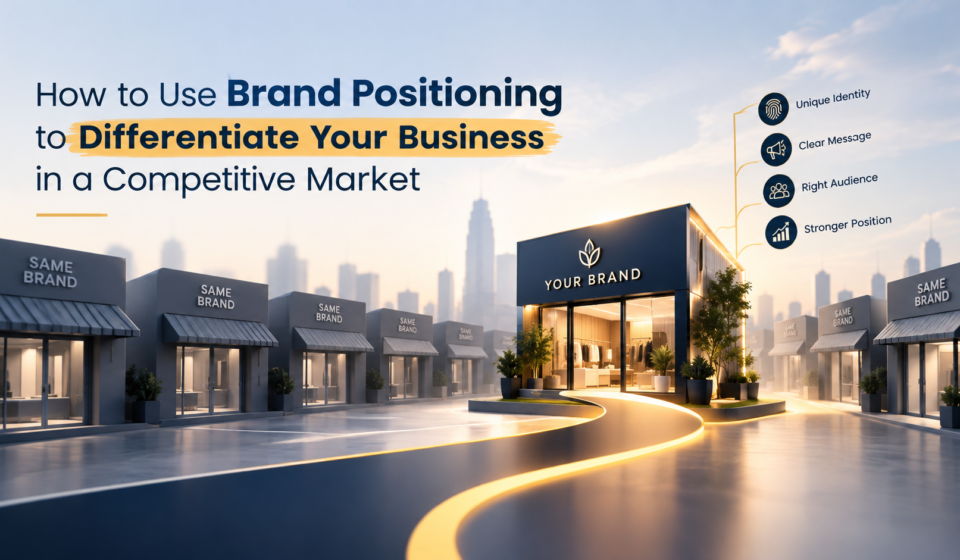

In today’s hyper-saturated digital economy, launching a great product is no longer enough to guarantee success. Markets are crowded, attention spans are shrinking, and consumers face an unprecedented paralysis of choice. When dozens of companies sell similar products with comparable feature sets at nearly identical price points, how do you convince a customer to choose your brand?
The answer lies in Brand Positioning.
Brand positioning is not about changing what you sell; it is about changing how your brand occupies space in the mind of your target customer. It is the deliberate, strategic process of defining where your brand sits relative to competitors and why you are the obvious, irreplaceable choice for a specific audience.
This ultimate guide breaks down how to build an undeniable brand positioning strategy to stand out, command higher pricing, and build long-term market dominance.
What Is Brand Positioning (and Why Does It Matter)?
Pioneered by marketing strategists Al Ries and Jack Trout, brand positioning is the process of setting your business apart from competitors in a way that creates distinct value for your target market.
“Positioning is not what you do to a product. Positioning is what you do to the mind of the prospect.” — Al Ries & Jack Trout
Without clear brand positioning, your business suffers from several critical vulnerabilities:
- Commoditization: You are forced to compete on price because customers perceive no functional or emotional difference between you and rivals.
- Confused Messaging: Marketing campaigns fail to resonate because you try to speak to everyone at once, ending up appealing to no one.
- Low Customer Retention: Customers switch to alternative platforms or products the moment a cheaper option appears because your brand lacks psychological stickiness.
                         Brand Positioning Impact Model
    ┌──────────────────────────────────────────────────────────────────────┐
    │                                                                      │
    │  WEAK POSITIONING                     STRONG POSITIONING             │
    │  • Competes on price                  • Commands premium pricing     │
    │  • Generic, forgettable messages      • Clear, hyper-targeted messaging│
    │  • High customer churn                • High brand loyalty & retention│
    │  • Indistinguishable from rivals      • Unique, defensible market niche│
    │                                                                      │
    └──────────────────────────────────────────────────────────────────────┘
The 4 Primary Types of Brand Positioning Strategies
To differentiate your business, you must select a strategic positioning angle that aligns with your core capabilities and market demand.
                              Brand Positioning Types
     ┌──────────────────────────────────┬──────────────────────────────────┐
     │      1. PRICE-BASED POSITIONING   │    2. QUALITY / LUXURY POSITIONING│
     │                                  │                                  │
     │  Focuses on affordability,       │  Emphasizes exclusivity, superior│
     │  accessibility, and maximum      │  craftsmanship, status, and      │
     │  value per dollar (e.g., Ikea). │  uncompromising quality (Apple). │
     └──────────────────────────────────┴──────────────────────────────────┘
     ┌──────────────────────────────────┬──────────────────────────────────┐
     │      3. CONVENIENCE / SPEED      │    4. HYPER-NICHE / SERVICE      │
     │                                  │                                  │
     │  Centers on saving time, zero    │  Tailors solution to an exact,   │
     │  friction, and instant access    │  underserved segment (ConvertKit │
     │  to solutions (e.g., DoorDash).  │  focusing on creators).          │
     └──────────────────────────────────┴──────────────────────────────────┘
1. Price-Based Positioning (The Value Play)
Positioning as the most affordable or cost-effective solution in the market.
- Pros: Rapid initial customer acquisition.
- Cons: Low margins, vulnerability to cheaper entrants, and potential perception of low quality.
2. Quality or Luxury-Based Positioning (The Premium Play)
Positioning as the highest-tier, elite option built on craftsmanship, status, and superior performance.
- Pros: High profit margins, strong brand loyalty, immunity to price wars.
- Cons: Requires significant capital investment in brand identity, user experience, and prestige.
3. Convenience and Speed-Based Positioning (The Frictionless Play)
Focusing entirely on saving time and eliminating hassle for the user.
- Pros: High adoption rates in fast-paced modern markets.
- Cons: Operationally expensive to maintain seamless delivery, logistics, or speed standards.
4. Hyper-Niche or Audience-Specific Positioning (The Specialist Play)
Focusing exclusively on a narrow, deeply defined customer segment that broad market leaders ignore.
- Pros: High conversion rates, word-of-mouth growth, minimal direct competition.
- Cons: Limited addressable market size unless scaled vertically over time.
Step-by-Step Guide: How to Position Your Brand to Stand Out
Follow this 5-step strategic framework to build a defensible market position from the ground up.
Step 1: Audit Your Current Market Standing
Analyze how your target audience currently perceives your brand. Ask your existing customers:
- What three words come to mind when you think of our brand?
- What specific problem were you trying to solve when you found us?
- Which alternative tools or services were you considering before choosing us?
Step 2: Conduct Competitive Mapping (Perceptual Mapping)
A Perceptual Map is a visual matrix used to map competitors along two key buying decision axes (e.g., Price vs. Quality, or Speed vs. Customization).
                            Perceptual Market Map
                    High Price / Enterprise Focus
                                │
                                │        Competitor A
                                │    (Expensive & Complex)
                                │
   Low Customization ───────────┼─────────── High Customization
   (Out-of-the-box)             │           (Tailored Solutions)
                                │  ★ YOUR SWEET SPOT
                                │ (Affordable & Tailored)
                                │
                        Competitor B
                   Low Price / Budget Focus
Identify the empty quadrant (“White Space”) where customer demand exists, but no competitor is serving adequately.
Step 3: Identify Your “Unfair Advantage”
Determine what your business does exceptionally well that competitors cannot easily copy, automate, or buy. Your unfair advantage could be:
- Proprietary Technology: A unique algorithm, framework, or process.
- Specialized Domain Expertise: Decades of hyper-focused industry knowledge.
- Customer Experience (CX): Unmatched response times and personalized service.
- Community Network Effects: An engaged user community that adds intrinsic value.
Step 4: Draft Your Brand Positioning Statement
A brand positioning statement is an internal guide that aligns all marketing, product design, and sales efforts. Use this classic formula:
“For [Target Audience] who struggle with [Primary Customer Pain Point], [Brand Name] is the [Product/Service Category] that provides [Key Value / Benefit]. Unlike [Primary Competitors], our brand [Primary Differentiating Feature/Approach].”
Real-World Example:
“For freelance digital marketers who struggle with complex client reporting, GrowthPulse Analytics is an automated reporting platform that delivers white-label dashboards in under 60 seconds. Unlike legacy enterprise analytics platforms, our tool requires zero coding and sets up instantly.”
Step 5: Express Your Positioning Across Every Touchpoint
Positioning is useless if it lives solely in an internal PDF document. It must be woven into every public-facing brand asset:
| Brand Touchpoint | How Positioning Is Applied |
| Website Above-the-Fold | Bold primary headline reflecting your core differentiator. |
| Sales Pitch Deck | Direct comparison charts highlighting competitor gaps. |
| Pricing Page | Clear plan structures aligned with target customer value perception. |
| Customer Onboarding | Messaging that reinforces why the user made the right choice. |
Case Studies: World-Class Brand Positioning in Action
1. Tesla vs. Legacy Automakers
- Old Positioning: Electric cars are slow, ugly, eco-friendly golf carts for tree-huggers.
- Tesla’s Shift: Electric cars are high-performance, futuristic, ultra-luxurious supercars that happen to run on clean energy.
- Outcome: Tesla revolutionized the automotive market by making sustainability aspirational rather than compromise-based.
2. Liquid Death vs. Standard Bottled Water
- Old Positioning: Bottled water is clean, pure, healthy, and associated with wellness/fitness.
- Liquid Death’s Shift: Canned water packaged like craft beer with heavy-metal punk aesthetic under the slogan “Murder Your Thirst.”
- Outcome: Built a multi-hundred-million-dollar beverage brand in a commoditized market simply through radical visual and cultural positioning.
The 5 Biggest Brand Positioning Mistakes to Avoid
- Trying to Please Everyone: Broad messaging makes your brand invisible. The narrower your initial focus, the stronger your market entry.
- Confusing Features with Benefits: Customers don’t buy features; they buy a better version of themselves. Position around outcomes, not specs.
- Failing to Adapt Over Time: Market dynamics change. Regularly review your positioning every 18–24 months to ensure relevance.
- Copying Market Leaders: Copying the industry leader’s messaging positions you as a second-rate knockoff rather than a legitimate alternative.
- Over-Promising and Under-Delivering: Strong positioning attracts buyers, but only product execution builds brand equity.
Execution Framework: How to Roll Out Your Positioning
1.Audit Current Perception & Competitors:Gather insights from real users and market data.
Run customer surveys and review competitor landing pages to map market gaps and uncover current brand misconceptions.
2.Craft & Finalize Positioning Statement:Establish internal alignment.
Draft your core positioning statement and get buy-in from leadership, sales, and marketing teams.
3.Overhaul Digital Assets & Visual Identity:Align all customer-facing touchpoints.
Update website headlines, ad creative hooks, sales scripts, and social media bios to reflect your new strategic position.
4.Track Key Performance Metrics:Monitor impact on key business indicators.
Evaluate conversion rates, customer acquisition costs (CAC), sales cycle lengths, and customer lifetime value (LTV) post-launch.
Strategic brand positioning is the ultimate force multiplier for business growth. When you clearly define who you are, who you serve, and why you are fundamentally different, marketing becomes easier, sales close faster, and customer loyalty soars.