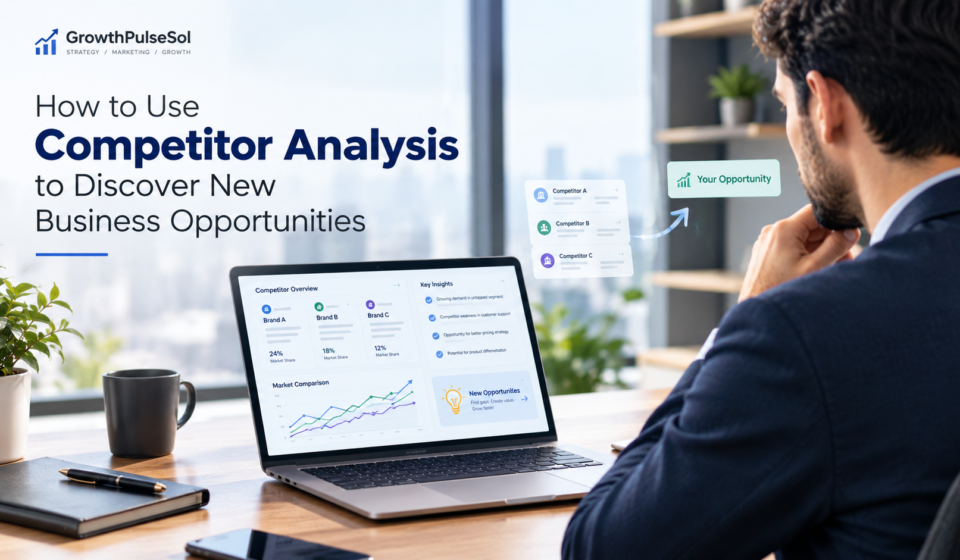

In the hyper-competitive global landscape, starting or expanding a business based purely on gut feeling is a recipe for failure. Long-term business success rarely comes from reinventing the wheel—it comes from analyzing existing wheels, identifying where they wobble, and building a smoother, more efficient model.
This is where Competitor Analysis transforms from a basic marketing exercise into a strategic growth engine.
Many entrepreneurs make the mistake of looking at competitors merely to imitate what they are doing. Real strategic intelligence, however, works in reverse: you study competitors to find out what they are NOT doing. By systematically identifying market gaps, underserved customer segments, pricing flaws, and feature omissions, you can uncover lucrative business opportunities that others have overlooked.
This comprehensive, step-by-step guide explores how to conduct deep competitor analysis to unlock high-growth business opportunities.
What Is Competitor Analysis (and What Is It Not?)
At its core, competitor analysis is the practice of identifying key players in your industry, evaluating their strategies, products, sales numbers, and marketing operations, and benchmarking your own business performance against them.
However, to use competitive analysis as an opportunity engine, you must understand the distinction between reactive tracking and proactive discovery:
- What it is NOT: Copying your competitor’s landing pages, cloning their products, or undercutting their prices by 5% to steal short-term market share.
- What IT IS: Finding structural weaknesses in their business models, identifying dissatisfied customer segments, discovering overlooked keywords, and pioneering new value propositions.
Step 1: Map Out Your Complete Competitor Ecosystem
Before uncovering opportunities, you need to know who you are actually competing with. Most business owners focus exclusively on direct rivals, ignoring alternative solutions that steal market share.
To build a complete competitive landscape, categorize your rivals into three distinct tiers:
                  ┌─────────────────────────────────┐
                  │      Competitive Landscape      │
                  └────────────────┬────────────────┘
                                   │
      ┌────────────────────────────┼────────────────────────────┐
      ▼                            ▼                            ▼
┌──────────────┐             ┌──────────────┐             ┌──────────────┐
│    Direct    │             │   Indirect   │             │ Substitute/  │
│ Competitors  │             │ Competitors  │             │  Aspirational│
└──────────────┘             └──────────────┘             └──────────────┘
1. Direct Competitors
These brands offer the exact same product or service to the same target audience. For example, if you run a cloud-based accounting software for freelancers, other freelance accounting software providers are your direct competitors.
2. Indirect Competitors
These companies offer different products or services but solve the same underlying problem for the target market. Using the accounting software example, an indirect competitor might be a general spreadsheet template provider or an offline bookkeeping consultancy firm.
3. Replacement or Substitute Competitors
These represent alternative choices customers use to solve their pain points without purchasing a software product at all (e.g., using pen and paper or doing manual calculations).
4. Aspirational Competitors
Market leaders or enterprise giants that set the standards and trends for the overall industry (e.g., QuickBooks or Xero).
Step 2: Uncover High-Value Market Gaps Using Customer Reviews
The fastest way to spot an untapped business opportunity is by finding out where your competitors’ customers are frustrated. Real user reviews are an absolute goldmine for product innovation and feature positioning.
Where to Collect Unfiltered Feedback
- B2B / SaaS: G2, Capterra, TrustRadius.
- E-commerce & Physical Products: Amazon, Trustpilot, Google Reviews.
- Digital Products & Apps: Apple App Store, Google Play Store, Reddit communities.
The 1-Star and 3-Star Review Mining Framework
Ignore 5-star reviews (often biased or generic) and 2-star complaints about shipping delays. Focus heavily on 1-star and 3-star reviews to identify recurring patterns:
| What Customer Reviews Say | The Hidden Business Opportunity |
| “The software is great, but the onboarding process took me 3 weeks.” | Build a simplified, plug-and-play competitor with automated onboarding. |
| “Their customer support takes 4 days to respond to simple queries.” | Position your brand around premium, 24/7 human-centered support. |
| “This tool has way too many bloated features I never use.” | Launch a hyper-focused “micro-app” targeting a single specific workflow. |
| “The pricing shot up after my first year as a small team.” | Offer predictable, transparent, flat-rate pricing for small businesses. |
Step 3: Conduct a SEO and Content Gap Analysis
Digital footprint analysis reveals what your target audience is searching for online that your competitors are failing to answer adequately.
Identifying Keyword and Search Gaps
Using tools like Ahrefs, Semrush, or Ubersuggest, analyze your top 3–5 direct competitors to pull a Content Gap Report:
- Uncover High-Volume, Low-Competition Keywords: Look for search phrases where competitors rank on Page 2 or 3 of Google due to thin or outdated content.
- Target “Competitor vs. Competitor” Search Intent: Create comparison pages (e.g., “Brand A vs. Brand B” or “Best Alternatives to Brand A”). People searching these terms are late in the buying journey and actively evaluating alternatives.
- Analyze Content Formats: If your competitors write 500-word general blog posts, produce in-depth interactive calculators, video walkthroughs, or downloadable templates to capture user interest.
                     ┌─────────────────────────────┐
                     │   Identify Target Topics    │
                     └──────────────┬──────────────┘
                                    │
                     ┌──────────────▼──────────────┐
                     │  Run Content Gap Analysis   │
                     └──────────────┬──────────────┘
                                    │
          ┌─────────────────────────┴─────────────────────────┐
          ▼                                                   ▼
┌───────────────────────────────────┐               ┌───────────────────────────────────┐
│ Competitor Ranks Poorly (Page 2+) │               │  Unaddressed Customer Search Terms │
└─────────────────┬─────────────────┘               └─────────────────┬─────────────────┘
                  │                                                   │
                  └─────────────────┬─────────────────────────────────┘
                                    │
                     ┌──────────────▼──────────────┐
                     │  Publish In-Depth, High-    │
                     │  Value Assets & Tooling     │
                     └─────────────────────────────┘
Step 4: Analyze Pricing Models and Value Positioning
Pricing is rarely just about numbers; it reflects how a business segments its market. Evaluating competitor pricing pages allows you to locate profitable structural gaps.
Common Pricing Gaps to Exploit
- The Missing Middle: Many industries have low-end budget tools (poor quality) and enterprise solutions ($10,000+/year). Introducing a high-quality mid-tier option can unlock massive revenue.
- Monetization Mechanics: If competitors charge per user seat, offer a flat-fee model for unlimited users. If they charge monthly subscriptions, introduce pay-as-you-go pricing for infrequent users.
- Unbundled Features: If a competitor bundles 10 complex features into an expensive plan, isolate the single feature that 80% of customers actually care about and sell it as a stand-alone product.
Step 5: Reverse-Engineer Their Marketing & Acquisition Channels
Where are your rivals getting their customers? Analyzing their distribution channels will reveal acquisition avenues you can dominate.
1. Organic Social Media & Community Presence
Audit their active profiles across LinkedIn, X, Instagram, and YouTube. Look for platform mismatches: if all your competitors focus exclusively on Google Ads, you might discover an underserved target market on TikTok or niche Reddit subreddits.
2. Paid Ad Strategy
Use tools like Meta Ad Library and Google Ads Transparency Center to inspect active ad creatives and copy from competitors.
- What pain points are they highlighting in their hooks?
- Which ad formats (video vs. carousel vs. single image) have been running the longest? (Long-running ads usually signal profitability).
3. Strategic Partnerships and Affiliates
Check who is linking to or promoting your competitors. High referral traffic often indicates active affiliate programs, influencer endorsements, or integration partnerships. Partnering with non-competing tools in the same ecosystem can grant immediate access to an established customer base.
Step 6: Convert Intelligence into an Actionable SWOT Matrix
Once raw data is collected across products, pricing, SEO, and reviews, synthesize your findings using an Action-Oriented Competitive SWOT Analysis:
                       Competitor SWOT Analysis
     ┌──────────────────────────────────┬──────────────────────────────────┐
     │            STRENGTHS             │            WEAKNESSES            │
     │                                  │                                  │
     │  • Strong brand authority        │  • Outdated UI / UX              │
     │  • Massive distribution network  │  • Poor customer support response │
     │  • Deep capital backing          │  • High enterprise pricing       │
     └──────────────────────────────────┴──────────────────────────────────┘
     ┌──────────────────────────────────┬──────────────────────────────────┐
     │          OPPORTUNITIES           │             THREATS              │
     │                                  │                                  │
     │  • Build simplified micro-app    │  • Market price wars             │
     │  • Target mid-market gap         │  • Rapid feature replication     │
     │  • Offer transparent pricing     │  • Platform policy updates       │
     └──────────────────────────────────┴──────────────────────────────────┘
Rather than conducting a SWOT analysis solely on your own company, map out a SWOT matrix for your top 3 competitors.
Your ultimate business opportunity lies at the exact intersection of your competitor’s primary WEAKNESS and an unserved market OPPORTUNITY.
Real-World Case Studies: Finding Market Gaps
Case Study 1: How Zoom Beat Legacy Video Conferencing
When Zoom entered the market, giants like WebEx, Skype, and GoToMeeting were already established. However, Zoom performed a competitive analysis that revealed deep customer dissatisfaction with software bloat, required downloads, complex installation steps, and unstable video lag.
- The Competitor Weakness: Bloated, unstable software requiring heavy installations and user account creation for attendees.
- The Opportunity: A frictionless, browser-friendly video tool prioritizing one-click link joining and low-latency streaming.
Case Study 2: How Canva Simplified Graphic Design
Adobe Photoshop was the uncontested leader in design software for decades. However, its complex interface required months of training and professional mastery.
- The Competitor Weakness: Steep learning curve, expensive licensing, and overly complex desktop installation.
- The Opportunity: A web-based, drag-and-drop design tool with pre-built templates built specifically for non-designers and small business owners.
5 Essential Tools for Competitive Intelligence
To execute this strategy efficiently, leverage modern digital intelligence tools:
- Semrush / Ahrefs: For identifying organic search traffic, content gaps, backlink profiles, and paid advertising keywords.
- G2 / Capterra: For analyzing real user complaints, software limitations, and feature requests.
- BuiltWith: To reveal the tech stack, analytics software, and third-party tools running on a competitor’s website.
- Google Alerts: To track real-time brand mentions, press releases, and executive announcements from your rivals.
- Meta Ad Library: To inspect active social media ad campaigns, creative hooks, and promotional messaging.
Execution Framework: From Discovery to Market Launch
1.Select Your Core Focus Area:Limit initial research scope to maintain momentum.
Choose 3 direct and 2 indirect competitors. Avoid getting overwhelmed by trying to audit dozens of brands at once.
2.Extract Pain Points and Market Friction:Analyze negative user feedback.
Read at least 50 user reviews across G2, Trustpilot, or app stores. Record every complaint related to pricing, missing features, onboarding speed, and customer service.
3.Audit Digital Acquisition Funnels:Uncover underlying marketing engines.
Study competitor landing pages, search keywords, active paid ads, and email newsletter flows to see how they capture leads.
4.Define Your Minimum Viable Differentiator (MVD):Establish clear market positioning.
Identify a single, compelling value proposition that directly resolves your competitor’s biggest flaw (e.g., faster setup time, simpler pricing, or targeted features).
5.Launch, Test, and Iterate:Validate actual market demand.
Build a landing page targeting customer pain points uncovered during research. Run targeted ad traffic or organic outreach to validate demand before investing heavy capital.
Competitor analysis is not about staying one step behind your rivals by reacting to their every move. It is about observing the market landscape to identify untapped paths, underserved customers, and friction points.
By treating competitor weaknesses as your blueprint for product development, messaging, and acquisition strategy, you can turn competitive research into your most powerful engine for long-term digital growth.