Why Search Engines Now Prefer “Experience-Driven” Content: The New Era of SEO

If you have noticed a sudden shift in your website’s performance recently, you are not alone. The old playbook of writing a broad summary of a topic, splashing a few strategic keywords across the page, and expecting to sit comfortably on page one of Google is officially dead.
We have entered a brand-new digital era. The internet is flooded with millions of mass-produced, automated articles that all sound identical. Because copycat text is easier to generate than ever before, search engines have completely changed how they grade quality.
Today, algorithms are aggressively filtering out generic theory. Instead, they are elevating experience-driven content—articles, guides, and insights created by real humans who have actually done what they are writing about. Let’s break down exactly why this massive shift is happening and how your brand can adapt to win the top rankings.
What Exactly is Experience-Driven Content?
Before reshaping your strategy, it is essential to understand what search engines are actively looking for.
The Human “E” in E-E-A-T
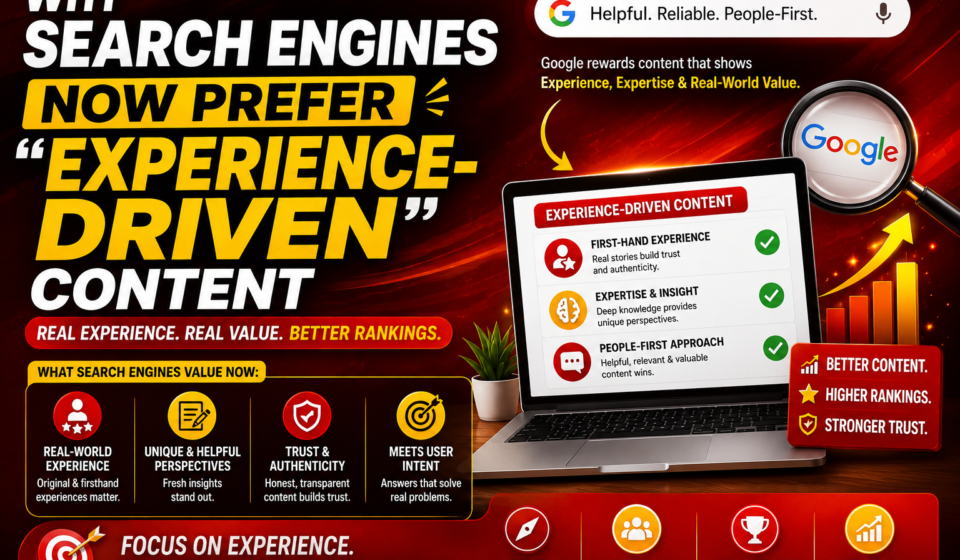
For years, Google relied on its core E-A-T framework (Expertise, Authoritativeness, and Trustworthiness) to evaluate web pages. However, the search landscape required a deeper layer of validation, leading to the addition of a second “E”: Experience.
Experience-driven material is content that displays first-hand, real-world involvement with a subject. It isn’t just an explanation of what a concept is; it is a breakdown of how it worked when the author personally tested it. It includes human observations, unique data points, distinct case studies, and real photos or screenshots.
Unlike cold, robotic summaries, experience-based content feels lived-in. It provides the unique context, operational trade-offs, and unexpected mistakes that only a real practitioner would know.
Why Search Engines are Making This Aggressive Pivot
The reason for this algorithmic shift comes down to a simple principle: preserving the helpfulness of search results for everyday users.
- Sifting Through the Automated Noise: Algorithms can spot basic text definitions with ease. Because generic content is everywhere, search engines use real-world experience as the ultimate filter to separate truly valuable sites from empty filler.
- Fulfilling Real User Intent: When someone searches for an analytical problem or a business framework, they don’t want a textbook definition. They want to hear from someone who has been in the trenches and solved it.
- Powering Generative Feeds: Modern search engines and automated summaries require highly specific, primary-source data to confidently answer user questions. They prefer to pull from domains that offer original insights rather than sites that merely rewrite existing articles.
- Securing Google Discover Placements: Algorithms look for authentic, non-clickbait content that mirrors deep topic-level expertise. Sites that lean into genuine human experience are highly rewarded on personalized user feeds.
The Landscape: Algorithmic Trends Dominating the Market
The digital ecosystem has evolved into a much more specialized space. To keep your visibility high, your content must reflect these modern shifts:
The Crackdown on Shallow Synthesizing
Writing generalized “ultimate guides” that offer nothing new is a quick way to lose organic presence. Modern search systems reward topical depth. If your platform doesn’t feature original research, expert quotes, or native media, algorithms will quickly bypass your pages in favor of authoritative voices.
Strict Clickbait Reduction Rules
Attracting clicks using sensational headlines that withhold basic context will actively damage your site’s health. Search engines heavily prioritize clear, authentic headlines that accurately represent the depth of the content inside.
Contextual and Semantic Connectivity
Modern search tools understand the web through direct entity relationships. They analyze how thoroughly a website covers an entire niche. To establish authority, your articles need to map out connected concepts, edge cases, and actionable solutions seamlessly.
4 Common Content Mistakes That Harm Your Rankings
Many website owners are still running their digital growth engines on outdated assumptions. Avoid these frequent missteps:
- Hiding Your Authorship Details: Publishing anonymous blog posts or using vague, corporate bylines destroys algorithmic trust. Always use clear author bios that outline real-world credentials and professional social links.
- Using Generic, Free Stock Imagery Exclusively: Flooding your pages with generic stock photos provides zero value. Prioritize original screenshots, process flowcharts, dashboards, or product pictures to visually prove your first-hand experience.
- Burying the Direct Answer: Forcing a user to scroll through five paragraphs of historical background just to find a simple definition will ruin your user engagement. Lead with immediate, clear value at the very top of your headings.
- Isolating Your Core Marketing Strategy: Treating your blog as a completely separate project from your main business offers minimal return. Ensure your experiential content ties directly back into your specialized services or product solutions.
Actionable Tips to Inject Experience Into Your Strategy
Ready to future-proof your digital assets? Use this clear framework to make your platform highly attractive to modern search engines.
1. Shift to a Case Study Mentality
Whenever you write an educational piece, anchor it with real-world application. Instead of writing a generic article on “How to Lower Ad Spend,” frame it as “How We Reduced a Retailer’s Ad Spend by 30% Using Specific Audience Segments.” Break down the challenges, the exact steps taken, and the measurable results.
2. Highlight True Edge Cases and Failures
Do not just share what works perfectly. Share what failed, what surprised you, and how you adapted. Discussing the limitations or exceptions of a business framework proves to both readers and search crawlers that you possess genuine, practical knowledge.
3. Build an Integrated Content Ecosystem
Ensure your technical site design supports your authority. Use clear internal links to guide readers from high-level educational insights smoothly into your primary service landing pages.
If managing this detailed technical structure, running comprehensive data audits, and consistently producing authoritative content feels overwhelming, partnering with an experienced digital agency is a smart move. To build highly responsive, future-proof funnels that capture consistent traction, exploring professional growth solutions at https://growthpulsesol.com/ can help you align your digital assets for maximum commercial impact.
Frequently Asked Questions (FAQs)
1. Does experience-driven content mean I can never write introductory guides?
Not at all. Beginners still need foundational overviews. However, your introductory guides should include real-world analogies, personal insights, or unique examples that prevent the text from sounding like a generic encyclopedia entry.
2. How can a business demonstrate experience if they are launching a new product?
Focus heavily on the development journey. Share behind-the-scenes content, highlight your specific testing phases, outline the user feedback you collected, and feature in-depth case studies from your early beta testers.
3. Do search engines look at author bios when determining content quality?
Yes. Transparent authorship is a vital trust signal. Providing visible author names, concise bios highlighting years of industry experience, and links to established professional profiles like LinkedIn helps search engines verify the credibility behind the words.
4. What are the best visual elements to display real-world experience?
The most effective visual elements include original interface screenshots, proprietary process charts, step-by-step video walk-throughs, data dashboards, and real photos of your team executing a service.
5. How long does it take for experience-based content to improve search visibility?
While deep organic authority takes roughly 3 to 6 months to build momentum, experience-based content generally earns engagement, social shares, and high-quality backlinks much faster than generic, rewritten material.
Conclusion: The Ultimate Competitive Advantage is Your Story
The digital landscape has fundamentally changed, but the ultimate goal remains the same: building authentic connection. Search engines prefer experience-driven content because it is the one thing that cannot be mass-produced, faked, or automated.
By injecting your real-world victories, operational trade-offs, and deep niche insights into every page, you protect your website from sudden algorithm shifts and build a powerful, organic source of revenue. Your unique perspective isn’t just an asset—it is your greatest competitive advantage.
Are you ready to stop publishing standard text and start scaling your digital presence with high-authority marketing funnels? Connect with Growth Pulse Solutions today, and let’s transform your industry experience into a powerful organic traffic engine.
For a complete breakdown of how recent core algorithm changes are shifting traffic landscapes, you might find this Google Discover Update 2026 Explained Video highly useful. It offers an excellent look at how search networks are prioritizing direct, human-driven expertise over sensational clickbait across mobile feeds.